



















Artificial intelligence has become a strategic lever for local governments. AFNOR’s recent white paper, “AI for Local Governments: How to Develop an AI Strategy Within a Local Authority,” makes clear that AI, including generative AI, shouldn’t be seen as just another technology tool. It’s a driver of transformation for public service, provided it’s deployed responsibly, ethically, and with a clear structure.
At NeoLedge, this vision already guides the design and evolution of our Elise solution for local authorities. We think of AI as a way to improve efficiency, support better decision-making, and strengthen transparency, all while staying true to the core values of public service.
Why is AI a strategic priority for local governments?
AI helps reduce processing times, automate repetitive tasks, and improve service quality. But these benefits only materialize when the technology is part of a clear strategy.
That’s the thinking behind Elise’s intelligent automation mechanisms and structured workflows. The goal isn’t just to speed up processes: it’s to make them more coherent, easier to manage, and better aligned with political priorities.
How should AI serve a local government’s political project?
AI isn’t a passing trend. It needs to align with a local government’s mandate and objectives, which might include:
- Improving internal performance
- Enhancing the quality of service to citizens
- Transforming organizational processes
With this in mind, Elise helps translate strategic vision into concrete action: organizing document flows, automating approval circuits, and improving how information moves between departments. AI becomes a structuring tool in service of the broader political project.
How can local governments use AI ethically and responsibly?
AI comes with real risks: bias, errors, lack of transparency, and regulatory non-compliance. Local governments need to:
- Protect public data
- Ensure human decision-making remains primary
- Account for environmental impact
- Put ethical governance frameworks in place
These principles sit at the heart of NeoLedge’s approach. With Elise, traceability of actions, data security, and human oversight remain central at every step. AI is there to support staff, never to replace them. It helps with analysis and content generation, while the final decision always stays in human hands.
What governance does a local AI project need?
A successful AI project depends on clear governance:
- Leadership at the highest level (mayor, president, general secretary)
- Involvement of business unit directors
- Integration into the existing digital strategy
Elise fits naturally into this kind of governance. By centralizing information, structuring workflows, and providing tracking and reporting tools, the solution enables coordinated, well-managed oversight across processes. AI integrates into the existing digital ecosystem without creating new silos.
What are the steps to deploy AI in a local government?
Turning AI into a genuine tool for the common good requires several key steps, from defining strategic objectives to structured rollout and ongoing evaluation.
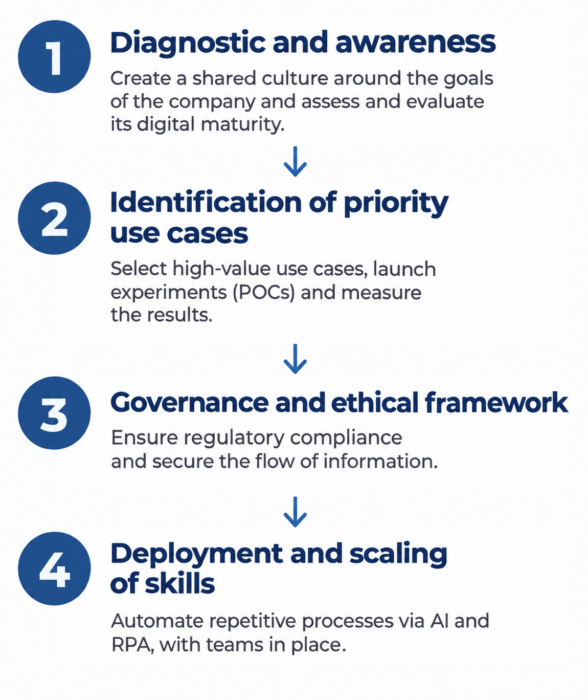
- Diagnostic and awareness: create a shared culture around the organization’s goals, and assess its digital maturity.
- Identification of priority use cases: select high-value use cases, launch experiments (POCs), and measure the results.
- Governance and ethical framework: ensure regulatory compliance and secure the flow of information.
- Deployment and scaling of skills: automate repetitive processes with AI and RPA, with the teams in place.
What can AI concretely change for a local government?
Beyond the principles, this is fundamentally an operational challenge. With Elise:
- Workflows become optimized and intelligent
- Repetitive tasks are automated
- Documents stay secure and quickly accessible
- Information is analyzed and synthesized to support decision-making, with Elise’s AI services
The result: local governments that are more responsive, more productive, and more accountable.
AI stops being a theoretical concept and becomes a tangible lever for continuously improving public service.
At NeoLedge, we believe artificial intelligence should strengthen public action over the long term, while upholding the standards of ethics, transparency, and performance that public service demands. With Elise, that ambition is already taking shape on the ground.
Want to see how? Contact us for a personalized demonstration.
FAQ: AI for local governments
Does AI replace local government staff?
No. With Elise, AI supports staff by helping with analysis and content generation, while the final decision always stays in human hands.
Who should lead an AI project in a local government?
Leadership at the highest level (mayor, president, general secretary), with the involvement of business unit directors and integration into the existing digital strategy.
What are the main risks of AI for a local government?
Bias, errors, lack of transparency, and regulatory non-compliance. Protecting public data, keeping human decision-making primary, and setting up ethical governance help manage them.