















Digital transformation is pushing organizations to become faster, more efficient, and more resilient. Against this backdrop, the shift to the cloud has become a major strategic lever.
But beyond operational gains, a different question now sits at the heart of digital strategy: data and infrastructure sovereignty.
For public and private organizations alike, it’s becoming essential to guarantee data location, maintain control over infrastructure, and protect against extraterritorial legislation. Choosing a cloud solution is no longer just a matter of performance. It now involves questions of trust, compliance, and digital independence.
Our SaaS offerings, Elise Cloud, Elise SecNumCloud, N-Cloud, and illico, support organizations through this transition by bringing together innovation, security, and control.
1. Digital sovereignty: a strategic priority
Digital sovereignty has become a decisive factor in choosing cloud infrastructure.
Organizations today face significant requirements around:
- Data location and hosting
- Protection against extraterritorial legislation
- National and European regulatory compliance
- Legal control over infrastructure
But sovereignty isn’t just about where servers are physically located. It also covers control over operators, data governance, transparency across subcontracting chains, and technological independence.
This is where Elise SecNumCloud rounds out NeoLedge’s offering. Designed to meet French regulatory requirements, particularly under the government’s “Cloud au Centre” doctrine, this solution is built for organizations facing strict security and sovereignty constraints.
Sovereignty becomes a lever for trust and control, while still allowing organizations to capture the full benefits of the cloud.
2. The Cloud: simplifying operations to boost performance
The first benefit of the cloud is operational.
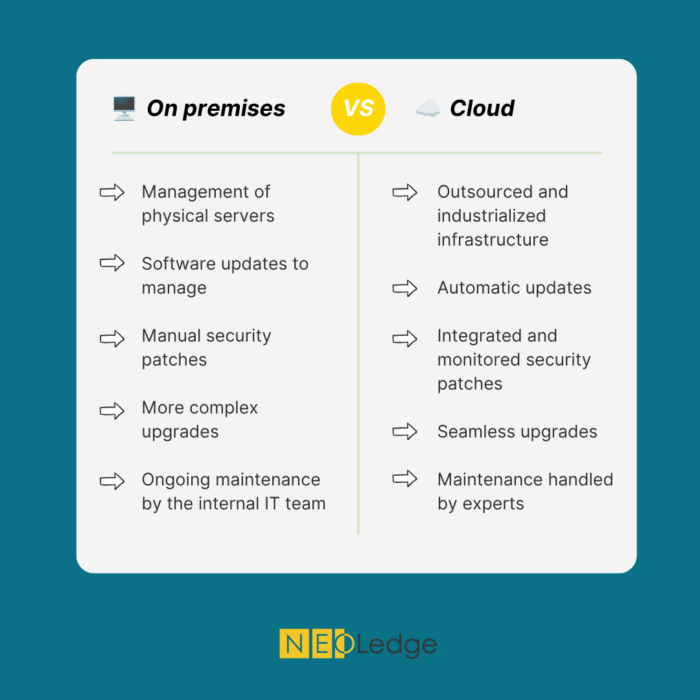
In an on-premises environment, the tasks IT teams have to manage consume significant resources and often generate costs that are easy to underestimate.
Cloud benefits, by contrast, are immediate:
- Less technical maintenance
- Fewer interruptions, with better service continuity
- Reduced risk of obsolescence
- Faster deployments
- Improved application availability
This frees up internal teams to focus on innovation and value creation instead of technical upkeep.
3. Security: a “by design” approach
Security is a foundational pillar of modern cloud architecture.
Elise Cloud’s infrastructure was built around a security-by-design approach. This means every component, every layer, and every process incorporates advanced protection mechanisms to prevent, detect, and contain threats.
This includes:
- Advanced protection mechanisms (encryption of data at rest and in transit, strict access controls)
- Continuous monitoring of security events
- Analysis and correlation tools (SIEM-type systems)
- Cloud security posture assessment tools (CSPM)
- Ongoing information security intelligence and monitoring
This proactive approach allows risks to be anticipated rather than simply managed after the fact.
4. Data control and protection
Moving to the cloud doesn’t mean losing control of your data. With Elise Cloud, your data remains fully protected and under your control, thanks to:
- Advanced encryption using state-of-the-art algorithms
- Flexible encryption key management, either managed by *NeoLedge or through a Bring Your Own Key (BYOK) model
- Strict flow controls that prevent unauthorized data extraction
- Continuous backup and data geo-redundancy
Strong commitments reinforce this security: guaranteed availability with a 99.9% SLA, GDPR compliance, and secure, auditable environments.
Your data stays protected, traceable, and under control at every stage.
5. A more realistic view of total cost
Comparisons between cloud and on-premises solutions are often skewed.
Comparing a cloud subscription to just the initial acquisition cost of an internal system doesn’t tell the full story. The real metric to look at is Total Cost of Ownership (TCO) across the software’s entire lifecycle.
On-premises costs include:
- License fees
- Hardware purchases (servers, storage, network equipment, etc.)
- Infrastructure (facilities, cooling, electrical safety)
- Installation and configuration
- Annual maintenance (roughly 20% of the initial cost)
- Regular upgrades (every 5 to 7 years)
- Operational staffing costs
These expenses make up the hidden part of the iceberg.
Cloud costs, by contrast, are far more transparent:
- Monthly or annual subscription fees
- Configuration and customization costs
- User training
This model is predictable, scalable, and aligned with actual usage. It reduces upfront capital expenditure (CAPEX), improves return on investment (ROI), and accelerates project timelines.
Moving to the cloud isn’t just a change of infrastructure. It’s a way to simplify operations, strengthen cybersecurity, keep control of your data, manage your budget more effectively over the long term, and adapt more quickly as business needs evolve.
Want to learn more about Elise Cloud? Contact us for a personalized demonstration.